APRIL 5, 2012
Welfare Sec. Alexander Discusses Mending the Safety Net on the BOX
On the latest edition of The BOX, Pennsylvania Department of Public Welfare Secretary Gary Alexander takes time to discuss proposed welfare reforms.
Despite accusations of wanting to "throw the poor out on the street," the reality is that in order to be able to support those who truly need assistance, reforms to the welfare system must occur. Secretary of Welfare Gary Alexander explains the Corbett Administration's plan to "mend the safety net," while encouraging individual independence, rather than dependence on the state.
Listen online to the 15 minute podcast and don't forget to subscribe to The BOX in iTunes.
To learn more about welfare reform, read our welfare reform policy points.
posted by ELIZABETH STELLE | 03:40 PM | 0 comment
APRIL 2, 2012
Human Services Programs Must Deal with Wasteful Spending
Last week, you couldn't swing a dead cat in the state capitol without hitting someone protesting Gov. Corbett's welfare spending reductions. The governor proposed combining six human service line items, such as Mental Health Services and Homeless Assistance, into a block grant that gives counties more discretion. In return for flexibility, Gov. Corbett hopes to control rapidly increasing welfare spending by reducing human services appropriations by 20 percent.
Yesterday at a public hearing (Subscription only), families expressed concern about spending cuts and the impact on 15,456 people waiting for services. The only solution they offer is more spending, and they don't care if it means higher taxes and a higher cost-of-living for everyone else.
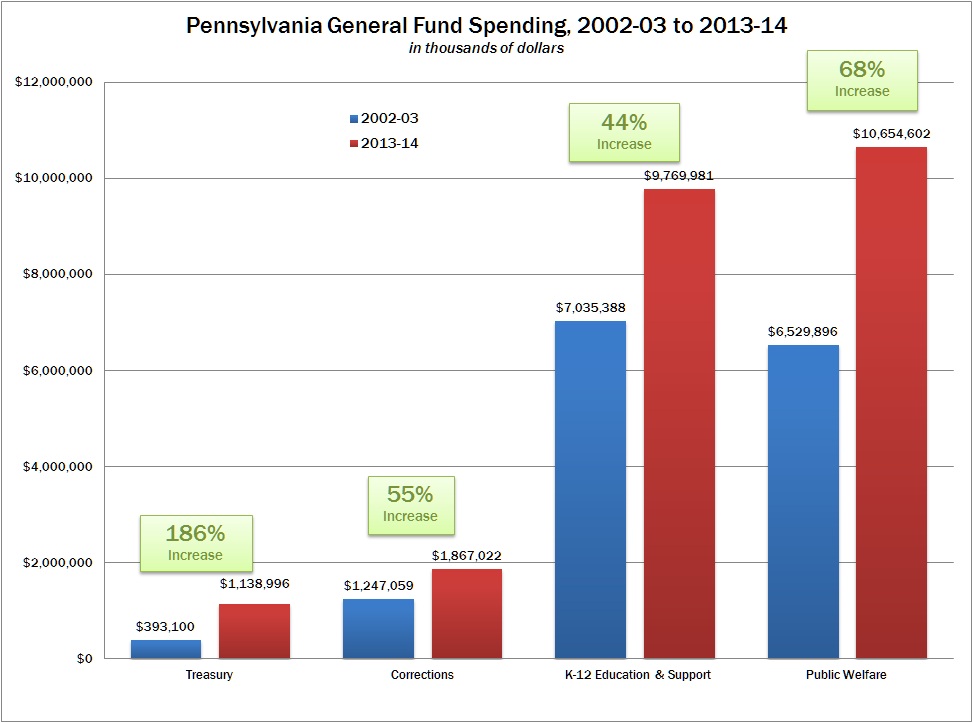
In Pennsylvania, welfare spending has increased three times faster than the rest of the state budget since FY 2002-03. If we continue down this path, you can rest assured living expenses, thanks to tax increases, will rise. But there is a way to cut the waiting list without increasing taxpayer's heavy burden -- eliminate wasteful spending.
Last fall, Department of Public Welfare Executive Deputy Secretary Tim Costa testified the lack of clear fiscal controls created a large amount of waste and prevented the department from serving more people. The Office of Developmental Programs (ODP), which serves those with intellectual disabilities, saw a budget increase of $664 million, or 60 percent, from FY 2004-05 to FY 2010-11, yet the number of individuals served increased only 27 percent. Costa explained:
All of us want the same thing - to provide quality services for those in need through a sustainable, successful program with clear and fair rules of the road for families and providers to follow. Lack of clear rules carries a real price. With almost 16,000 persons with intellectual disabilities on the waiting list hoping to enroll into the system and get the services they need, the need for reform is urgent.
So what kind of waste is occurring? One example is the policy of paying for empty nursing home beds. If a patient leaves a facility for a hospital stay or other temporary absence for treatment, the federal government will match payments for up to 30 days to reserve the bed. However, state rules allow payment for an empty bed for 48 days, and if the patient leaves for medical treatment, there is no limit to how many days ODP will pay to keep that bed empty. Between these temporary vacancies and permanent vacancies, ODP shouldered $30 million in state costs just in the last fiscal year.
Gov. Corbett's welfare proposals are not about punishing the disabled, but maximizing the number of people that can be served with a sustainable budget.
posted by ELIZABETH STELLE | 02:30 PM | 0 comment
MARCH 29, 2012
Do Government Programs Grow the Economy?
While decades of increased government spending have resulted in economic stagnation, many advocates of increasing government spending claim that their favored program will "grow the economy." They argue that if government takes taxpayer money and "invests" it, that is the path to prosperity.
Think of the economy as a small lake. If you fill a bucket on one side of the lake, walk around to the other side (spilling some along the way), and pour the water back into the lake, you aren't increasing the total amount of water in the lake. But that is exactly how a lot of spending advocates argue government programs will grow our economy.
This argument ignores the basic fact that government has no money of its own, other than that which it takes from taxpayers. Claims that any program "creates" economic growth look only at the seen effect of government spending, not the unseen effect of taking that money out of the economy through higher taxes. How much better would families and businesses spend and invest their own money than politicians?
Economist Greg Mankiw looks at a couple of studies that estimate $1 of government spending will result in $1 to $1.40 in GDP growth. But he then points to evidence that $1 in lower taxes will grow the economy by $3:
By contrast, recent research by Christina Romer and David Romer looks at tax changes and concludes that the tax multiplier is about three: A dollar of tax cuts raises GDP by about three dollars.
In a Mercatus brief, Veronica du Rugy and Jakin Debnam ask "Does Government Spending Stimulate Economies?" Their review concludes that economists disagree widely on how much government spending effects the economy, but it appears higher taxes do more harm to the economy:
Some economists find spending multipliers that are smaller than 1.3 Other economists, however, assert that spending multipliers are much larger.4 Still others argue that multipliers can't even be credibly measured.5
... Barro and Redlick's research estimates that the multiplier for changes in defense spending that people think will be temporary - spending for the Iraq war for example - is between 0.4 and 0.5 at the time of the spending and between 0.6 and 0.7 over two years. If the change in defense spending becomes permanent, then these multipliers increase by 0.1 to 0.2.11 Over time, this is a maximum multiplier of 0.9. Thus even in the government's best-case spending scenario, all of the estimated multipliers are significantly less than one. This means greater government spending crowds out other components of GDP, particularly investment.
In addition, they calculate the impact on the economy if the government funds the spending with taxes. They find that the tax multiplier-the effect on GDP of an increase in taxes-is -1.1. This means that if the government raises taxes by $1, the economy will shrink by $1.1. When this tax multiplier is combined with the effects of the spending multiplier, the overall effect is negative. Barro and Redlick write that, "Since the tax multiplier is larger in magnitude than the spending multipliers, our estimates imply that GDP declines in response to higher defense spending and correspondingly higher tax revenue."12 Thus, they conclude that greater government spending financed by tax increases hurts the economy.
Finally, here is a great piece by Matt Mitchell on how economists disagree on the stimulus effects of government spending:
In a 2010 interview, future economic Nobel Laureate Thomas Sargent was asked about the economic advice given to President Obama about that same stimulus bill. He replied: "President Obama should have been told that there are respectable reasons for doubting that fiscal stimulus packages promote prosperity, and that there are serious economic researchers who remain unconvinced."
Indeed, there is quite a range of professional opinion. Reasonable economists, using valid techniques have found that $1.00 in government purchases can create as much $2 or $3 in new private sector economic activity. But, unfortunately, other, equally-reasonable economists using equally-valid techniques have estimated that $1.00 in government purchases crowd out or destroy as much as $3 or $4 in private sector economic activity.
Pennsylvania faces a four-alarm fire threatening our fiscal house. And the only way to fireproof the Pennsylvania economy is to control government spending, not take more from taxpayers.
posted by NATHAN BENEFIELD | 02:27 PM | 0 comment
MARCH 21, 2012
No School Tax Referendums in Pennsylvania this Year
Remember the gnashing of teeth over "cuts" in state education subsidies (driven by the end of federal stimulus money)? The education establishment and partisan critics of Gov. Corbett insisted this would result in massive property tax increases.
You will also remember that the General Assembly passed legislation reducing the number of exemptions to the school tax referendum requirement. Add to that the fact that the base "index"— the level above which school districts must seek voter referendum on tax increases— is only 1.7 percent. This contrasts to recent school district property tax increases, which averaged 5.2 percent per year over the past decade, even factoring in "relief" from gambling revenue (see chart below).
Surely this combination of factors would result in a bevy of school tax referendums in 2012. But the Reading Eagle reports that not a single district in Pennsylvania is seeking a tax referendum this year.
In other words, schools, thanks to decades of funding increases, are able to make ends meet without going to local taxpayers for significant tax hikes (except for pension increases, which remain exempt, and will be a cost driver for decades).
But that doesn't mean we shouldn't help school districts stretch their budgets further. Matt Brouillette and Pennsylvania School Boards Association Executive Director Thomas Gentzel's recent op-ed in the Allentown Morning Call explains how prevailing wage reforms and economic furloughs will allow districts to do more with less.

posted by ELIZABETH STELLE, NATHAN BENEFIELD | 00:38 PM | 0 comment
MARCH 16, 2012
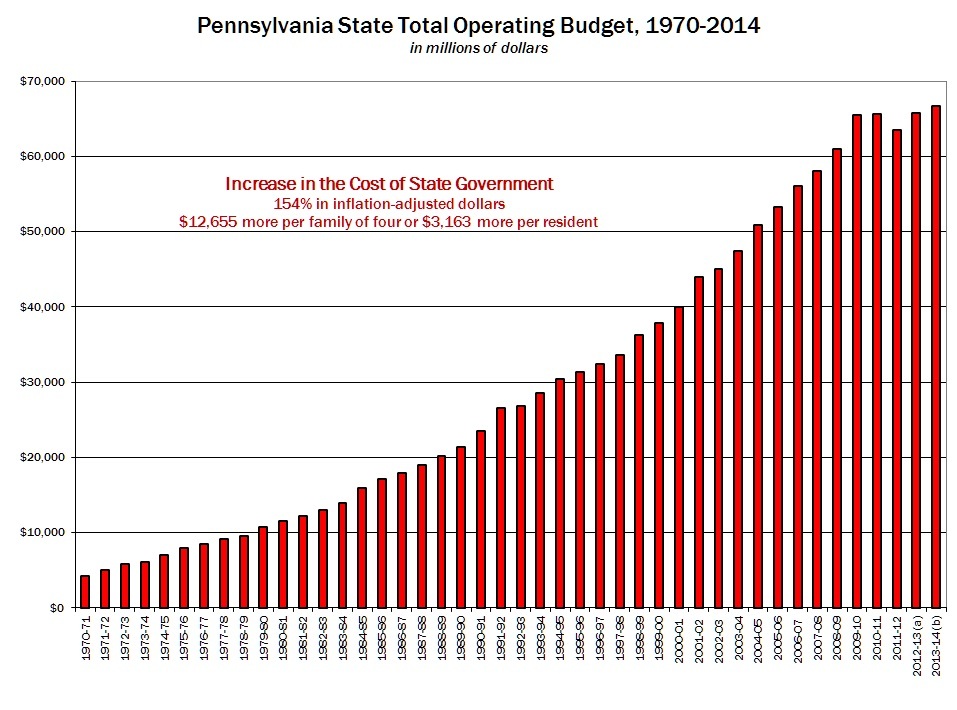
Chart of the Day: Pennsylvania Operating Budget since 1970
Pennsylvania's total state operating budget increased for 40 consecutive years before being reduced last year. The cumulative increase of 151 percent—adjusted for inflation—represents more than $12,000 per family of four in the Keystone State.

For more, check out The Four Alarms.
posted by NATHAN BENEFIELD | 05:39 PM | 0 comment
MARCH 15, 2012
Principled, Punchy Pols Are Popular Pols
I've written previously in this space about Louisiana Gov. Bobby Jindal, who has garnered enormous popularity while governing courageously. Today, with a new Quinnipiac poll about Gov. Tom Corbett's popularity engendering lots of chatter, I want to turn your attention to another relevant governor: Mitch Daniels of Indiana.
These days, Gov. Daniels is a rock star. Just yesterday, one of our CF supporters told me how much he wished Gov. Daniels would run for president, and believe me, he wasn't the first. Observers nationwide have toasted Gov. Daniels' effectiveness in turning the Hoosier State around. What we forget today, though, is that in the middle of his first term, this prophet had no honor in his hometown. The Indianapolis Star ran a pretty unambiguous headline on November 25, 2007: "50% disapprove of Daniels' work." The story noted that the year before, Gov. Daniels' approval rating had been an even lower 37 percent.
You might think, based on that, that Gov. Daniels subsequently turned tail and/or became a private citizen. You'd be wrong. He hasn't let up on taking a scalpel to spending. Less than a year after that poll came out, he won reelection resoundingly, garnering "more votes than any candidate for any public office in the state's history." And since then he has signed a right-to-work law and a major expansion of school choice.
Too many here in Harrisburg think constant caution or even cowardice creates confidence. Gov. Daniels' story says otherwise. We elect leaders to lead. Sometimes that entails making difficult decisions, and we expect those to be explained compellingly along the way. That's exactly what Gov. Daniels has done in Indiana, and the results are obvious—not just in terms of his own political standing, but by the people of his state being better off.
Here's hoping that as this enormously consequential year continues, politicians here in Pennsylvania learn the lessons Gov. Daniels can teach us.
posted by CHARLES MITCHELL | 01:27 PM | 0 comment
MARCH 5, 2012
Chart of the Day: Welfare Spending
Total welfare spending in Pennsylvania more than tripled from 1991 to 2012, rising 227 percent. During the same period (1991-2011) population rose by a paltry 6.7 percent. It goes without saying that this rate of spending is unsustainable for taxpayers, but it's also bad for the truly needy who become dependent on unaffordable benefits.

For more on welfare spending and the systematic reforms needed to end the cycle of higher poverty, read our report on reforming Pennsylvania welfare spending.
posted by ELIZABETH STELLE | 10:30 AM | 0 comment
MARCH 2, 2012
Big Government Limits Economic Growth

Last month, Gov. Tom Corbett's budget address kicked off state budget negotiations. As lawmakers debate priorities, one thing is crystal clear—low government spending fosters economic growth.
- The Mercatus Center's Matthew Mitchell outlines how economists studying living standards across the world find that low taxes, modest government budgets, reasonable regulations, free-markets and property rights lead to a stronger economy. "The benefits of freedom are profound: per capita income in the world's freest countries is about seven times that of the least-free."
- The World Bank's January publication "Golden Growth," acknowledges that big government through higher taxation limits growth. Taxes inevitably grow government, creating more bureaucracy and reducing private sector growth.
- Russ Roberts' post on "Post-war austerity" shows that we don't have to remain dependent on government spending. Roberts shows that after WWII, government successfully reduced its size without harming the economy.
It is clear that reducing the size of our bloated government is necessary to grow the economy. State policymakers took a significant step in this direction by enacting the first year-to-year reduction in state spending in at least four decades. The only way to protect our fiscal house and fireproof Pennsylvania's economy for ourselves and for generations to come is to maximize freedom by restraining government spending.
For more on protecting our economy, read Sen. Eichelberger and Rep. Bloom's commentary Sounding the Alarm to Save Pennsylvania or watch our new video, The Four Alarms.
posted by ALEJANDRO GARCIA | 11:19 AM | 0 comment
FEBRUARY 29, 2012
5 Scary Facts about Pennsylvania's Welfare Spending
Welfare spending in Pennsylvania is out of control. The Department of Public Welfare is now the largest department in the state. It will continue to crowd out education, environmental protection and public safety if the status quo continues.
- Forty cents of every state tax dollar goes to welfare spending.
- Welfare spending grew three times faster than the rest of the state budget since FY 2002-03. Welfare spending is growing faster than overall state spending, Pennsylvania's economy, and poverty.
- The number of Pennsylvanians in poverty increased nearly 50 percent in the last decade. The state's poverty rate has been climbing since 2000, regardless of economic conditions.
- Welfare spending is projected to grow five times faster than revenue for 2011-14. The Pennsylvania Independent Fiscal Office suggests General Fund revenue growth will average only 1.6 percent annually for 2011-14, while Public Welfare spending is projected to grow 8 percent per year.
- In 2001, three Pennsylvanians were working for every individual getting welfare benefits. Today that ratio has dropped to two to one. One out of every five Pennsylvanians is receiving some type of state welfare benefit.
The status quo is not sustainable. It is failing the poor and wages a heavy burden on taxpayers. Principled welfare reforms can reduce spending while protecting benefits for the truly needy and promoting the dignity of work.
posted by ELIZABETH STELLE | 10:48 AM | 0 comment
FEBRUARY 16, 2012
Busting the Myth That State Subsidies Prevent College Tuition Rising
Universities consistently blame state budget cuts for rising tuition, but in reality, tuition has risen regardless of state subsidies. Here's my letter exposing this myth in today's Philadelphia Inquirer:
The editorial on cuts to higher education in Gov. Corbett's budget perpetuates the myth that state subsidies prevent tuition hikes ("Corbett again targets colleges," Feb. 8). Taxpayers provided nearly $3.5 billion to Penn State over the last decade, while tuition doubled to $15,250. And subsidies of $1.9 billion did not prevent tuition from doubling at Temple. In fact, tuition rose even in years when the state subsidy increased. Most interesting, though, is that despite state cuts to taxpayer subsidies, Penn State's tuition hike last year was the lowest percentage increase in a decade.
If we truly want to make higher education within reach for families, why not tie state subsidies to tuition caps?
The cost of higher education is clearly out of control, but fanning the flames by distributing large chunks of money to institutions with no strings attached does nothing to lighten the burden on students or their parents.
posted by ELIZABETH STELLE | 00:45 PM | 0 comment

RSS FEEDS


.jpg)


.jpg)